Children cannot benefit from food they cannot access
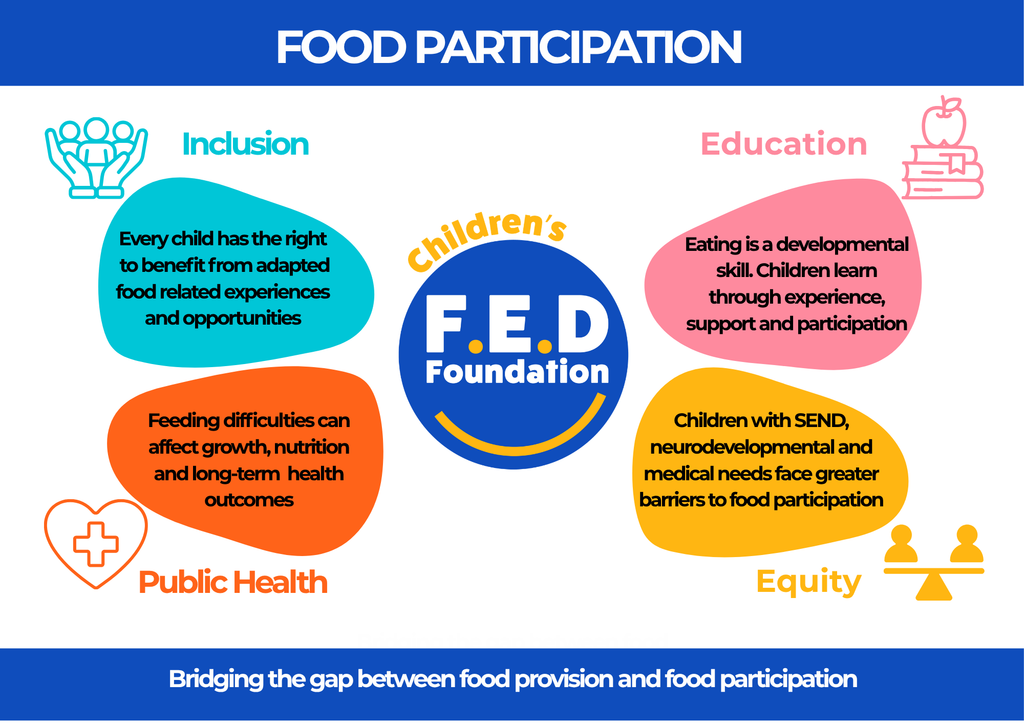
For many children, having food available is not the same as being able to eat it, enjoy it or participate in the experiences that surround it.
Across health, education and food policy, significant effort is rightly invested in improving the quality, availability and nutritional value of food. However, far less attention is given to whether children can access, engage with and benefit from that food in meaningful ways.
For children with feeding difficulties, neurodevelopmental differences, disability or complex medical needs, barriers to participation can exist long before a meal begins.
The Children’s F.E.D. Foundation exists to help bridge that gap.
Food participation is the ability to take part in food-related experiences in ways that are meaningful, safe and appropriate for each child.
It is not simply about what a child eats. It is about whether children can:
- Participate in food-based activities at home and school
- Develop feeding and self-help skills
- Explore food through learning and experience
- Build confidence around food and eating
- Participate in celebrations, trips and community events
- Develop social connections through shared food-based experiences
- Experience choice, autonomy and belonging
Food participation recognises that feeding development influences much more than nutrition. It influences learning, relationships, inclusion, independence and quality of life.
Why participation matters
When feeding difficulties are viewed purely through a nutritional or medical lens, children can miss out on important opportunities for development and inclusion.
For many children, the greatest challenge is not the food itself. It is participating in the environments where food is part of everyday life.
This may affect:
- Learning and educational experiences
- School meals and lunchtime participation
- Friendships and social inclusion
- Family routines and relationships
- Emotional wellbeing and confidence
- Independence
- Community participation
Participation matters because children learn through doing. The same principle applies to feeding development.
The Eating as Learning Framework
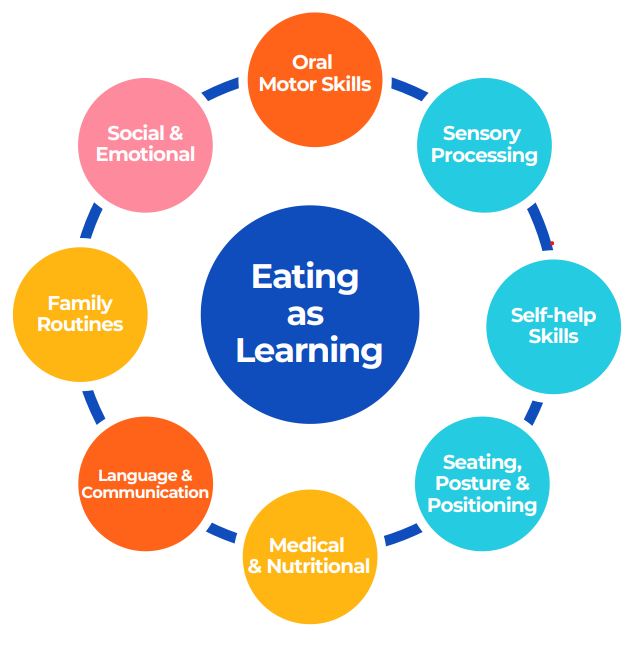
Understanding food participation led directly to the development of the Eating as Learning Framework. Children learn to eat through the interaction of:
- Feeding skills
- Sensory experiences
- Communication
- Relationships
- Regulation
- Learning opportunities
- Participation in everyday life
The Framework helps parents, practitioners and educators understand feeding as a developmental process rather than a simple outcome measured by food intake alone.
By focusing on participation, strengths and skill development, the Framework supports a more inclusive and realistic understanding of feeding progress.
The Eating as Learning Framework in Practice
For families
The Parent Community helps families understand feeding development, build confidence and support participation within everyday routines and experiences.
For healthcare professionals
The Eating as Learning Framework provides a developmental and participation-focused approach to assessment, intervention and parent partnership. Through training, supervision and professional networks, practitioners are supported to apply the framework within clinical practice.
Find out more about the EaL Framework for healthcare professionals here. (Insert hyperlink)
For education settings
The Eating as Learning Curriculum translates feeding development into practical learning opportunities within schools and early years settings. Rather than focusing solely on what children eat, the curriculum helps educational settings support:
- Food exploration
- Participation
- Independence
- Communication
- Confidence
- Inclusion
This creates opportunities for children to build feeding skills through everyday educational experiences.
Explore the Eating as Learning Curriculum ?(Insert hyperlink)