Feeding Development Matters
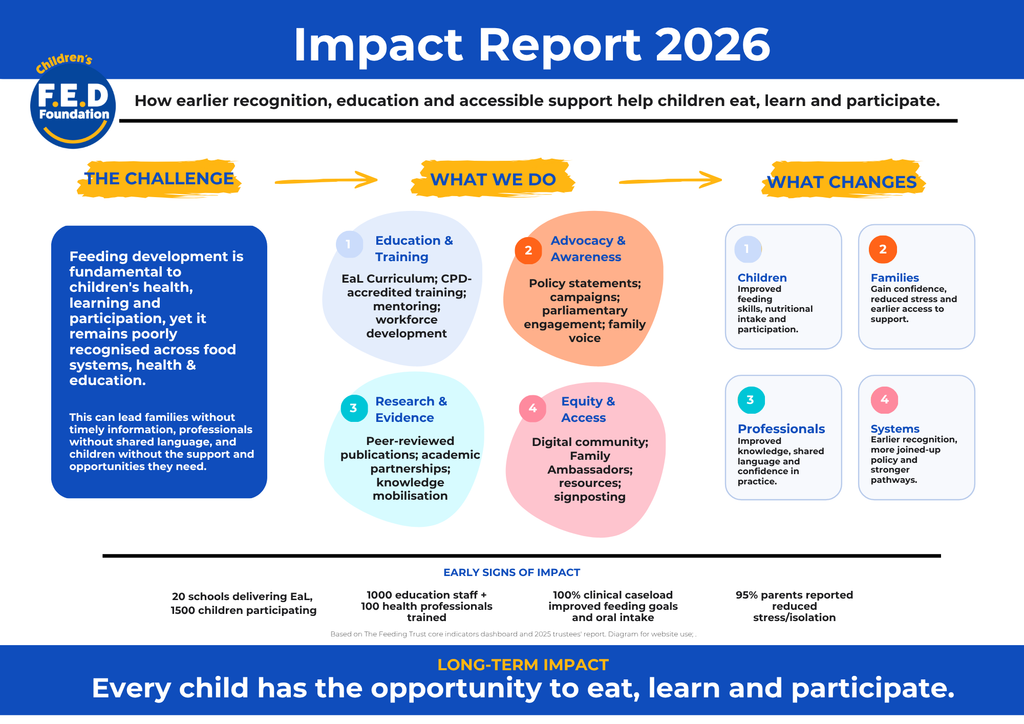
If feeding development is recognised earlier, understood better, and supported consistently, more children will have the opportunity to grow, learn and participate.
How We Create Change

Education & Training
What we do
- Deliver the Eating as Learning (EaL) Framework and Curriculum.
- Provide CPD-accredited training for education, health and community professionals.
- Develop practical tools for schools, families and practitioners.
- Support implementation through mentoring and ongoing guidance.
Outputs (2025-26)
- 20 schools implementing the Eating as Learning Curriculum.
- Approximately 2,000 children benefiting through curriculum activity.
- Over 900 education professionals reached through training and workshops.
- Over 100 healthcare professionals trained, including speech and language therapists, occupational therapists, dietitians and psychologists.
- CPD accreditation achieved through the UK CPD Accreditation Service.
- 100 additional schools reached through short courses and awareness training.
- New Early Years and Secondary/FE curricula in development.
Advocacy & Awareness
What we do
- Amplify the voices of children and families.
- Work with policymakers and professional bodies.
- Develop evidence-informed campaigns.
- Promote feeding development as a recognised component of childhood development.
Outputs (2025-26)
- Parliamentary drop-in event at Portcullis House.
- Position statements published on SEND Reform and School Food Standards.
- Launch of The Children’s F.E.D. Foundation.
- Launch of “The Missing Milestone” campaign calling for feeding development to be recognised within the Personal Child Health Record (Red Book).
- Participation in national forums including Birmingham Food Action, School Food Networks, Council for Disabled Children activities and regional specialist networks.

Research & Evidence
What we do
- Conduct and publish research.
- Partner with universities and research institutions.
- Translate evidence into practical guidance, policy and workforce development.
Outputs (2025-26)
- Two peer-reviewed publications completed.
- Oral presentation at the European Academy of Childhood Disability Conference.
- Poster presentation at the UK Swallowing Research Group Conference.
- Three in-print research collaborations with University College London.
- Development of national Paediatric Feeding Disorder Community of Practice.
Equity & Access
What we do
- Build a national digital community.
- Develop community-based support networks.
- Train local practitioners and ambassadors.
- Create practical resources for families and professionals.
Outputs (2025-26)
- Direct service support provided to approximately 50 children and families.
- Food bank pilot supporting 6 families.
- Development of the Foundation’s digital community platform.
- Recruitment of volunteer ambassadors and community supporters.
- National reach through training, online events, conferences and parliamentary engagement.
Evidence of Impact
The Feeding Trust’s clinical and educational work provides strong evidence that feeding development can be changed when support is provided.
Feeding skills: 100% of children on the charity’s clinical caseload achieved successful feeding skill outcomes, with an average improvement of 120.5% across medical, nutritional, feeding-skill and psychosocial domains.
Nutrition: 100% of children improved oral intake following intervention, including substantial increases across food groups and fluid intake.
Family wellbeing: 95% of parents reported reduced stress and isolation, while 95% reported increased mealtime confidence.
Professional reach: More than 900 education professionals, 100 health professionals and 600 parents participated in training, webinars and learning opportunities.
Looking Forward
The Feeding Trust was established to support children with significant feeding difficulties. The Children’s F.E.D. Foundation builds on that legacy with a broader ambition. Our vision is a future where feeding development is recognised as fundamental to every child’s health, learning and participation.
By working across education, advocacy, research and equity of access, the Foundation aims to help ensure that more children receive support earlier, fewer families reach crisis point, and feeding development becomes part of the national conversation about childhood development.